The 50/30/20 rule: how it works (with a practical example)
The 50/30/20 rule is the world's most famous budgeting method because it requires a single operation: splitting your net income into three parts. 50% for needs, 30% for wants, 20% for savings. Let's see how it works with real numbers and how to check it every month.
The three buckets
- 50% — Needs: rent or mortgage, utilities, groceries, commuting costs, medications, essential payments. Everything you can't give up without serious consequences.
- 30% — Wants: eating out, streaming subscriptions, gym, travel, shopping. The expenses that make life enjoyable but that you could give up.
- 20% — Savings (and debt): emergency fund, investments, extra debt repayments. The classic advice: move it on payday, not with "whatever is left over" (nothing is ever left over).
Example with a $3,000 net paycheck
| Bucket | Share | Amount | Examples |
|---|---|---|---|
| Needs | 50% | $1,500 | Rent $1,050, utilities $170, groceries $280 |
| Wants | 30% | $900 | Eating out, streaming, gym, weekends |
| Savings | 20% | $600 | Automatic transfer to a savings account |
When the rule doesn't add up (and how to adapt it)
In many big cities rent alone eats more than 50% of an average paycheck: the rule is not a dogma. If your needs are at 60%, try a 60/25/15: what matters is that the three buckets exist and that savings aren't zero. The rule gives you a structure — the numbers you adapt yourself.
The weak spot of 50/30/20 is that you have to know how much you actually spend in each bucket — and almost nobody does. That's where tracking comes in: without data, the rule remains a good intention.
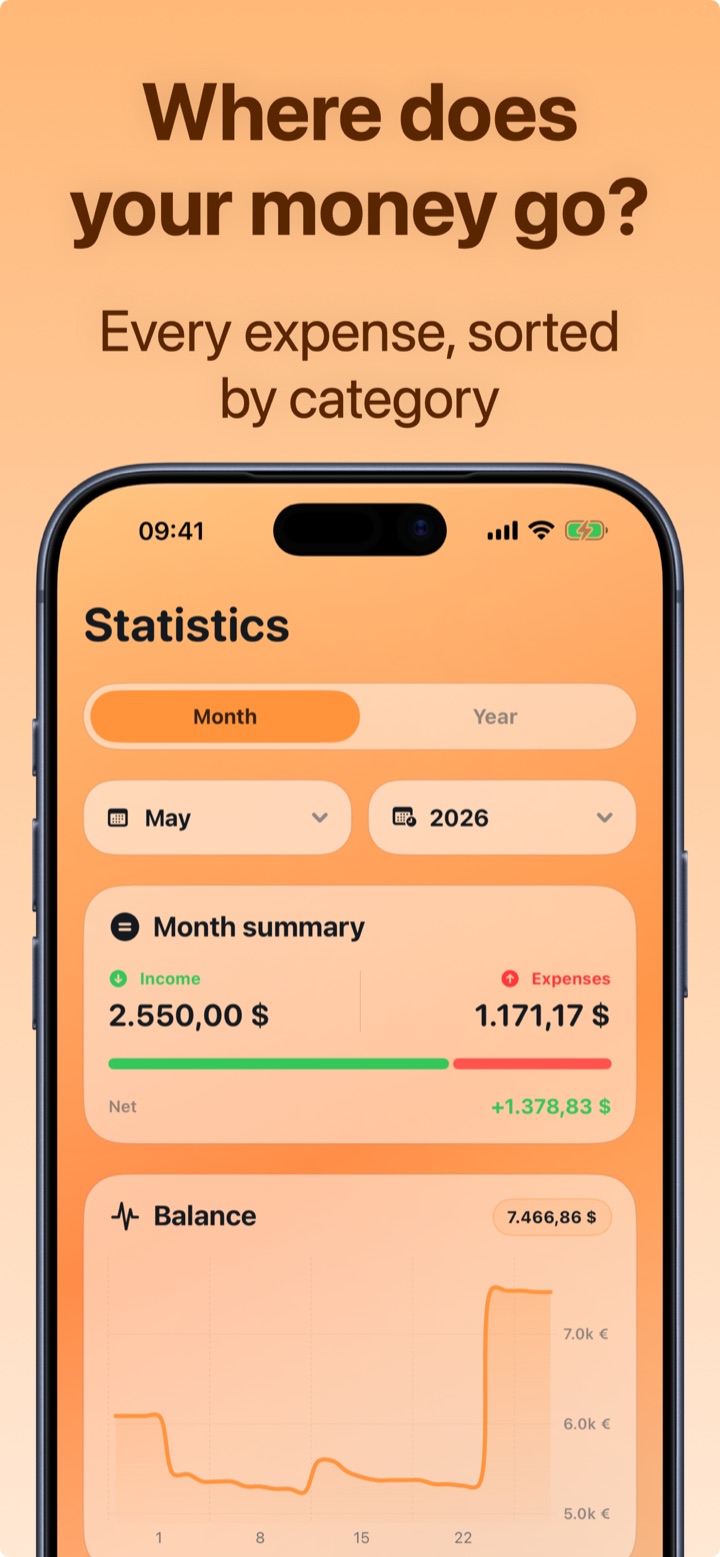
How to apply the 50/30/20 rule with Crena
- Calculate the three thresholds from your net income (e.g. $3,000 → 1,500/900/600).
- On payday, set aside the 20%: treat it as a mandatory expense, not as leftovers.
- In Crena, set your monthly budget to needs + wants (in the example, $2,400).
- Log expenses by category: Home and Food tell the story of the "needs" bucket, Shopping and Leisure the "wants" one.
- At the end of the month open Statistics → Categories and compare the totals with your thresholds: you'll immediately see which bucket is off and by how much.
Frequently asked questions
Does the 50/30/20 rule work with a low income?
The principle does, but the percentages need adapting: with high fixed costs try 60/25/15 or 70/20/10. What matters is keeping the savings bucket, even a small one.
Does the mortgage go under needs or savings?
The mortgage payment goes under needs (it's an obligated expense). The 20% is for extra repayments and building capital.
How do I know if I'm sticking to the percentages?
You need to track expenses by category: in Crena the monthly statistics show each category's total, to compare against your three thresholds.

Try Crena for free
Expenses in two seconds, monthly budget and clear statistics. No sign-up and no bank account linking.
Download on theApp Store